ElevenLabs was valued at $11 billion in its February Series D. Seven months later, investors agreed to buy $300 million of shares from employees and existing holders at a price implying a $22 billion valuation. The company’s private price marker doubled even though this was not another conventional primary fundraising round.1
ElevenLabs completed a $300 million employee tender at a $22 billion valuation, twice its February Series D valuation. The tender lets employees and existing holders sell shares rather than functioning like a conventional primary raise. A private-company valuation can therefore reset through secondary trading without the transaction cash primarily funding the company.1, 2
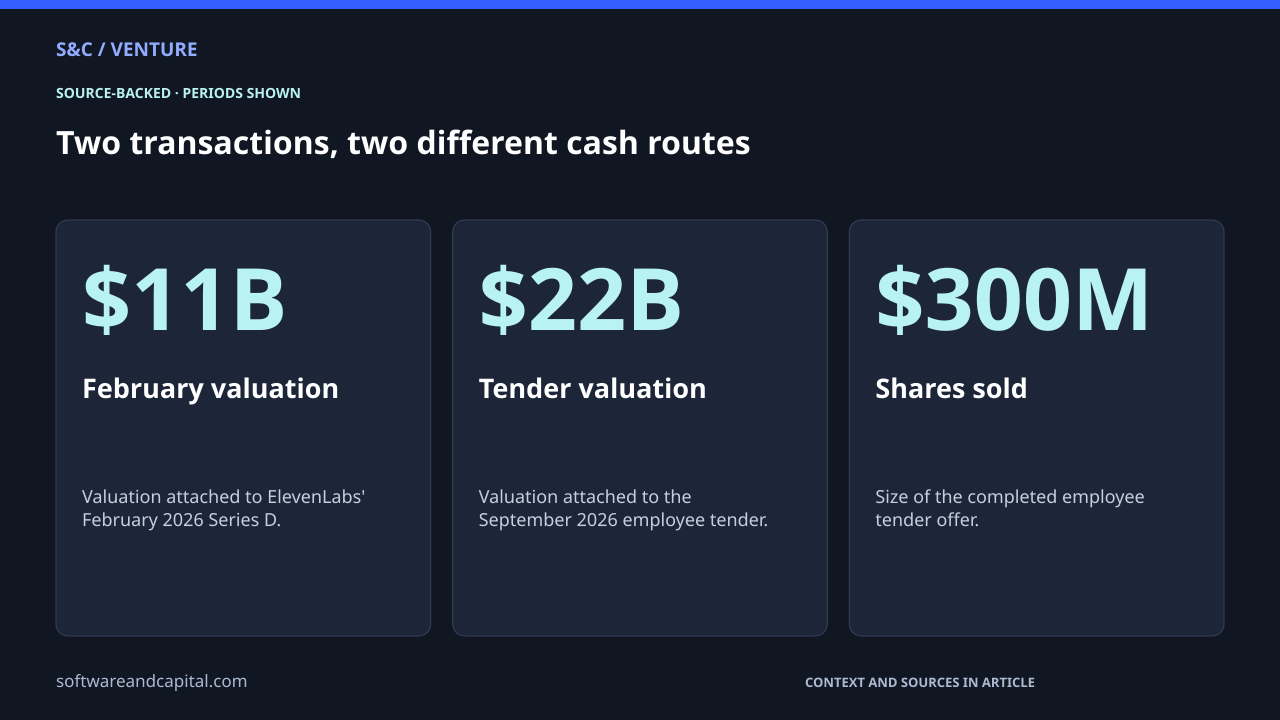
Two transactions, two different cash routes
A secondary sale can reset the price without funding the company
In a primary round, investors buy newly issued shares and the company receives the financing. In an employee tender, investors buy shares from existing holders. The price paid for those shares can still establish a new valuation reference even though the transaction cash goes primarily to the sellers.1
| Transaction | Who sells | Who gets the cash | Can it create a valuation mark? |
|---|---|---|---|
| Primary funding round | Company issues new shares | Company | Yes |
| Employee tender / secondary | Employees or existing shareholders sell existing shares | Selling holders | Yes |
| Public-market trade | Public shareholder sells listed stock | Selling shareholder | Continuously, through the market price |
The valuation doubled because investors accepted a new share price
A private valuation is derived from the price paid for a class of shares and the company’s capital structure. If a credible secondary transaction clears at a materially higher price, the implied company valuation can move even without new primary capital entering the business.
S&C has already explained the tender mechanism through Stripe’s employee-liquidity transaction. ElevenLabs adds a different question: how a secondary transaction itself can become the new private valuation marker.
Liquidity can also be a retention tool
TechCrunch reports that the tender gave employees an opportunity to sell shares while the company remains private. That can convert part of paper wealth into cash without requiring an IPO, reducing the pressure for employees to wait indefinitely for liquidity.1
What the $22 billion does not tell us
- How much cash ElevenLabs itself received, if any, from the secondary transaction.
- What every employee paid for their shares or earned by selling them.
- What the company would be worth in a continuous public market.
- Whether the next primary financing or future tender would clear at the same price.
The useful lesson is not that ElevenLabs 'raised $300 million at $22 billion.' It is that investors bought $300 million of existing shares at a price that reset the private valuation to $22 billion. Same headline number, very different cash route.
Sources and methodology
Sources checked September 30, 2026. Dates and periods for individual figures are stated beside them.
- ElevenLabs: $300M employee tender at $22B valuation ↗Accessed 2026-09-30
- TechCrunch: ElevenLabs employee tender ↗Accessed 2026-09-30
Scope and assumptions
The tender valuation is a private transaction price signal, not a continuous public-market price.
Public reporting does not establish that the $300 million went to ElevenLabs as company financing. it describes an employee/existing-holder tender.
Continue reading
$159B Valuation: Stripe’s Payday Without an IPO →
5 Numbers That Explain Where Figma’s IPO Money Went →
Five $100K SAFEs at a $5M Cap Sell 10% of a Startup—Not 2% →