AI agents become a different business when they have to answer a renter, schedule a tour, follow up on a lead and connect the conversation to property-management software. EliseAI says that vertical approach has now taken it past $200 million in annual recurring revenue.1
EliseAI says it has surpassed $200 million in annual recurring revenue and raised $350 million at a $4 billion valuation. Its model is vertical: automate communication and operating workflows in housing and healthcare rather than sell a general chatbot. Those figures show scale, but they do not reveal margins, retention or how much deployment work sits behind the software.1, 2
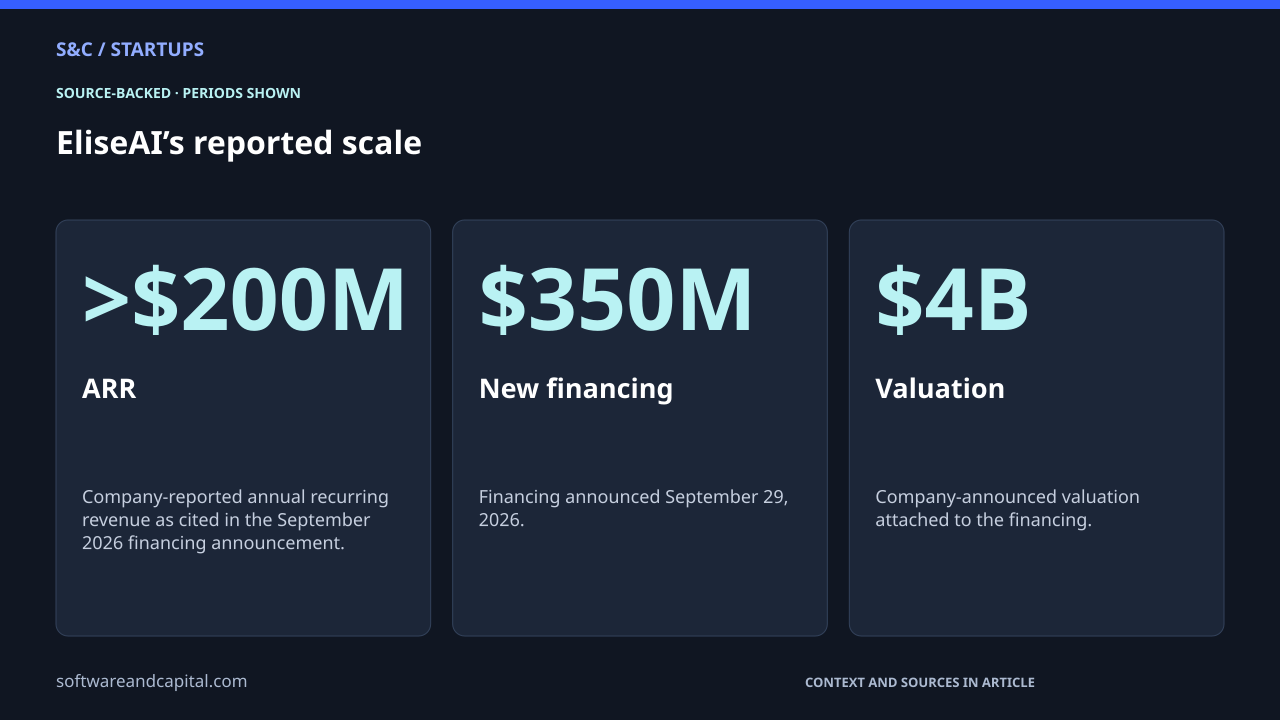
EliseAI’s reported scale
Vertical AI owns more of the workflow than a chatbot
EliseAI focuses on housing and healthcare workflows where conversations connect to operational systems. In housing, the company describes automation across leasing, resident services, maintenance and renewals.1, 2
| Point | What it means |
|---|---|
| >$200M ARR | Recurring-revenue scale, but not gross margin or retention. |
| $4B valuation | The financing price, not a forecast of future public-market value. |
| 1 in 6 U.S. apartments | Company-reported footprint, not usage depth or revenue per apartment. |
Deployment can be part of the moat and part of the cost
Vertical software can gain an advantage from integrations, workflow knowledge and operating context that general tools lack. The same depth can make implementation harder. Without margin and retention disclosures, ARR cannot tell us how efficiently that revenue is delivered.1
Housing is the proof point; healthcare is the expansion bet
The financing announcement presents housing as the established business and healthcare as an area for deeper expansion. The next question is whether the same workflow model transfers across another regulated, operationally complex industry.1
What would make the economics clearer
- Gross margin and the amount of human implementation or support required per customer.
- Net revenue retention or another measure of expansion and churn.
- Revenue mix between housing and healthcare as the second vertical scales.
EliseAI’s reported ARR makes vertical AI harder to dismiss as a collection of pilots. It still leaves the most important business-quality questions unanswered, which is why ARR, valuation and operating economics should stay separate.
Sources and methodology
Sources checked September 29, 2026. Dates and periods for individual figures are stated beside them.
- EliseAI: $350 million financing announcement ↗Accessed 2026-09-29
- EliseAI: platform overview ↗Accessed 2026-09-29
Scope and assumptions
ARR, apartment footprint and growth figures are company-reported.
The announcement does not disclose gross margin, retention, services mix or audited annual revenue.
Continue reading
AI Is Moving Into Plumbing and HVAC Software →
Entrata Nearly Doubled Revenue With Fewer Employees. It Credits AI for Much of the Efficiency →
Airbnb Says AI Now Resolves Nearly 45% of Support Issues Without a Human →