Enhanced geothermal has spent years in the category of promising energy technology. Fervo now has a larger physical proof point. The first 33-megawatt GeoBlock at Cape Station in Utah is synchronized to the grid and exporting electricity, moving the project from drilling and construction into actual power generation.1
Fervo says the first 33 MW GeoBlock at Cape Station is exporting electricity to the grid. Phase I is about 100 MW, roughly 900 MW of Cape Station offtake is contracted, and another 400 MW phase is under construction. First power is an operating milestone, but it is not the same as full commercial operation of the whole project.1, 2, 3
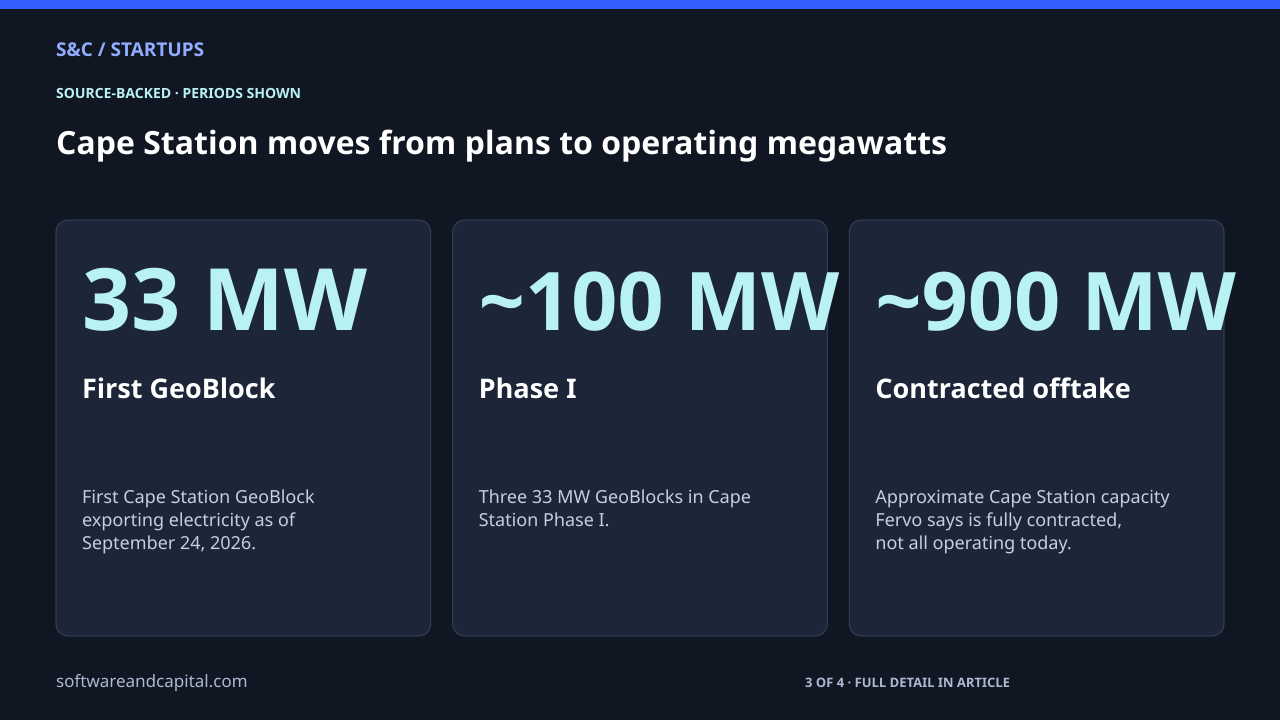
Cape Station moves from plans to operating megawatts
Approximate Cape Station capacity Fervo says is fully contracted, not all operating today.
Horizontal drilling is the core technology shift
Traditional geothermal projects depend on locations where underground heat and natural permeability line up conveniently. Fervo uses horizontal drilling, multistage stimulation and subsurface monitoring techniques adapted from oil and gas to create controlled flow paths through hot rock. Its goal is to make geothermal development less dependent on rare naturally favorable reservoirs.1, 3
| Stage | Status | What it means |
|---|---|---|
| First GeoBlock | First power achieved | Electricity is flowing to the grid while the unit ramps toward contractual commercial operation. |
| Remaining Phase I units | Commissioning | Two more GeoBlocks are expected to reach contractual commercial operation by January 1, 2027. |
| Phase II | Under construction | An additional 400 MW is planned for commercial operation in 2028. |
| Longer-term Cape Station | Development potential | Fervo has disclosed about 4.3 GW of total capacity potential, much of it not yet operating. |
First power is not full commercial operation
The first unit is generating electricity, but Fervo says its contractual commercial-operation date comes after commissioning and ramp-up. The remaining Phase I blocks are still being commissioned. That distinction matters because a project can be physically online before every contractual performance condition has been met.1
The demand side is already unusually visible
Fervo says roughly 900 MW of Cape Station offtake is fully contracted. An August SEC filing describes a 396 MW power purchase agreement with Google, delivered in four 99 MW tranches beginning in 2028, plus a possible expansion option that could push Google's contracted capacity higher if a later agreement is reached.1, 2
Contracted capacity is not the same as operating capacity. It does show that buyers are willing to sign long-term agreements before all of the generation assets are complete. For a capital-intensive power project, those contracts can matter as much as a technology demonstration because they support financing and construction decisions.
The comparison is with firm power, not only solar and wind
Enhanced geothermal is attractive because it can produce electricity around the clock rather than only when the sun shines or wind blows. That does not make it universally cheaper or easier to build. It makes it a different type of grid resource, especially for large loads that value continuous supply.1
What still has to happen after first power
- Ramp the first GeoBlock to contractual commercial operation.
- Finish commissioning the remaining Phase I units.
- Complete the 400 MW Phase II build on its planned schedule.
- Convert longer-term capacity potential into financed, permitted and operating projects.
S&C's AI electricity constraint analysis explains why power availability has become a technology-business bottleneck. Cape Station is the supply-side counterpart: one new generation method is beginning to move from pilot projects into utility-scale construction and contracted delivery.
The important milestone is narrower than saying enhanced geothermal has solved the power problem. One 33 MW block is now producing electricity. If the rest of Cape Station follows, the story becomes how quickly that engineering approach can be repeated at hundreds and eventually thousands of megawatts.
Sources and methodology
Sources checked September 28, 2026. Dates and periods for individual figures are stated beside them.
- GlobeNewswire: Fervo Energy announces Cape Station first power ↗Accessed 2026-09-28
- Fervo Energy: August 2026 Google PPA filing ↗Accessed 2026-09-28
- Fervo Energy: 2026 IPO prospectus ↗Accessed 2026-09-28
Scope and assumptions
Fervo's claim that Cape Station is the first utility-scale greenfield enhanced geothermal development to reach first power is company framing and is not independently adjudicated here.
Only the first 33 MW GeoBlock has reached first power. Most contracted and potential Cape Station capacity is not operating today.
Future commercial-operation dates, expansion options and long-term capacity are forward-looking and can change.
Continue reading
AI’s Next Constraint May Be Electricity, Not Intelligence →
Two Weeks to Hours: AWS Is Using AI Agents to Speed Grid Connections →
The AI Data-Center Boom Has a Picks-and-Shovels IPO: Accelevation Revenue Rose 176% →