Software coding agents can regenerate a function in seconds. Hardware teams face a harder problem: one requirement change can ripple through CAD, simulation, embedded code, testing and certification. Flow Engineering has raised $50 million to make that cross-system coordination agentic.1, 2
Flow Engineering raised a $50 million Series B at a $750 million valuation. The company says its agents connect requirements, CAD, simulation, code and testing across hardware programs, and that Rivian usage expanded from 40 to 1,500 users in seven months. Those adoption figures are company-reported. claims that hardware iteration can fall from months to days are not independently verified.1, 2
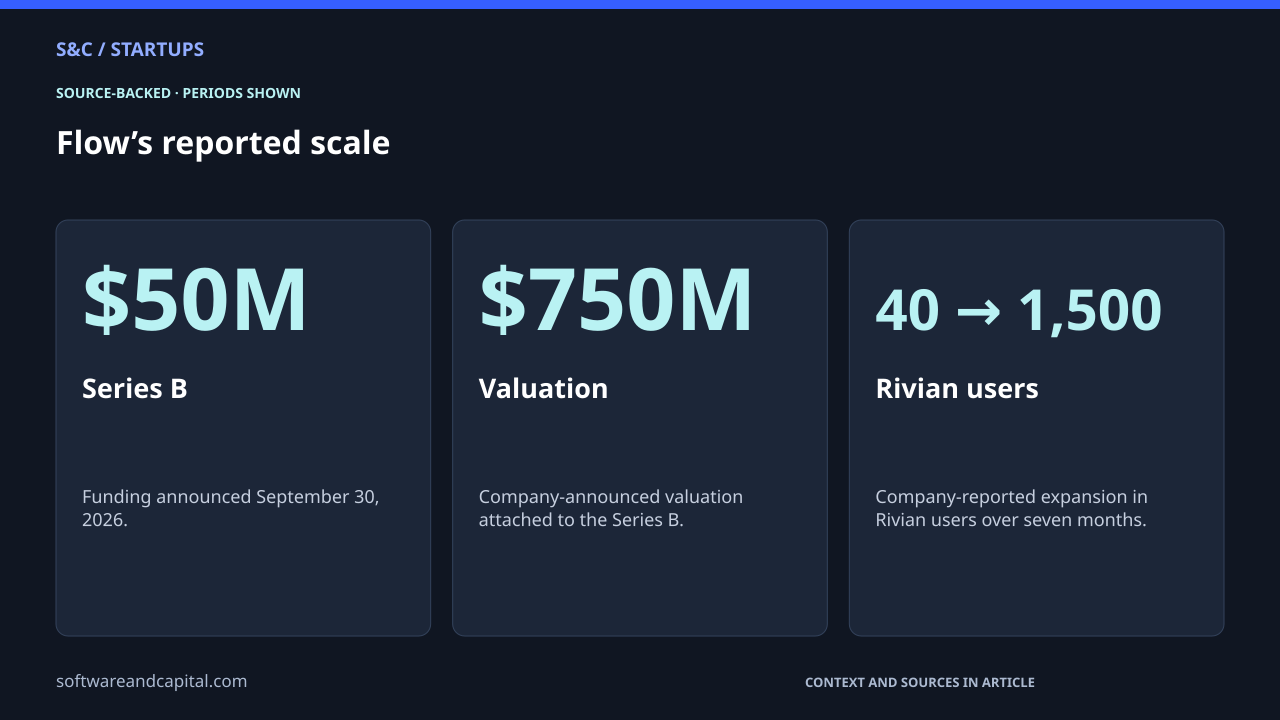
Flow’s reported scale
Hardware agents are coordinating changes, not just generating text
Flow describes agents that operate across requirements, systems engineering, CAD, simulation, software and test artifacts. That makes the product closer to a change-propagation layer than a general chatbot for engineers.2
| Engineering layer | What can change | Why coordination matters |
|---|---|---|
| Requirements | Performance, cost or safety target | Downstream designs may become invalid |
| CAD / simulation | Geometry, loads or thermal assumptions | Physical behavior must be rechecked |
| Embedded software | Control logic and interfaces | Hardware/software boundaries can shift |
| Test / certification | Evidence and validation | Changes may require new verification |
The adoption signal is stronger than the speed claim
The most concrete evidence in Flow’s announcement is usage: named customers and the reported Rivian expansion from 40 to 1,500 users. The broader claim that hardware iteration can move from months to days is a company thesis, not a controlled productivity study.1
The harder moat may be engineering context
A useful hardware agent needs access to the web of dependencies around a product, not just a prompt. If Flow becomes the layer that knows which requirement affects which drawing, simulation and test, the accumulated engineering context may matter more than raw model quality.2
What would prove the business case
- Measured reduction in engineering change-cycle time.
- Fewer late-stage rework loops after design changes.
- Evidence that usage persists across multiple vehicle or hardware programs.
- Clear controls around approval, verification and safety-critical changes.
The coding-agent analogy is useful only up to a point. Hardware work is slower because reality has to be simulated, built and tested. Flow’s opportunity is to make the coordination between those steps much faster without pretending the physical verification step disappears.
Sources and methodology
Sources checked October 1, 2026. Dates and periods for individual figures are stated beside them.
- Flow Engineering: $50M Series B announcement ↗Accessed 2026-10-01
- Flow Engineering: Series B memo ↗Accessed 2026-10-01
Scope and assumptions
Customer adoption figures and performance claims are company-reported.
The announcement does not provide an independent productivity study or detailed customer-level ROI data.
Continue reading
A Securities Firm Put AI Coding Agents Across Its Entire Engineering Team →
The AI Coding Boom Is Creating Software to Fix What Coding Agents Leave Behind →
Qualcomm Is Buying the Open-Source Software That Helps Robots Move →