Most online grocery stores start with a search box. Instacart's Clementine starts with the meal or household problem instead. A user can ask for kid-friendly lunches, a high-protein dinner or a pantry restock, and the assistant can turn that intent into recipes, product choices and a ready-to-buy cart.1, 3
Instacart's Clementine can turn a conversation, recipe or list into a personalized grocery cart using store inventory, past orders and household preferences. Instacart says early Clementine orders contain more items than a typical basket and exceed its $115 average basket size. The same underlying technology also powers Cart Assistant on retailers' own sites and apps.1, 2, 3
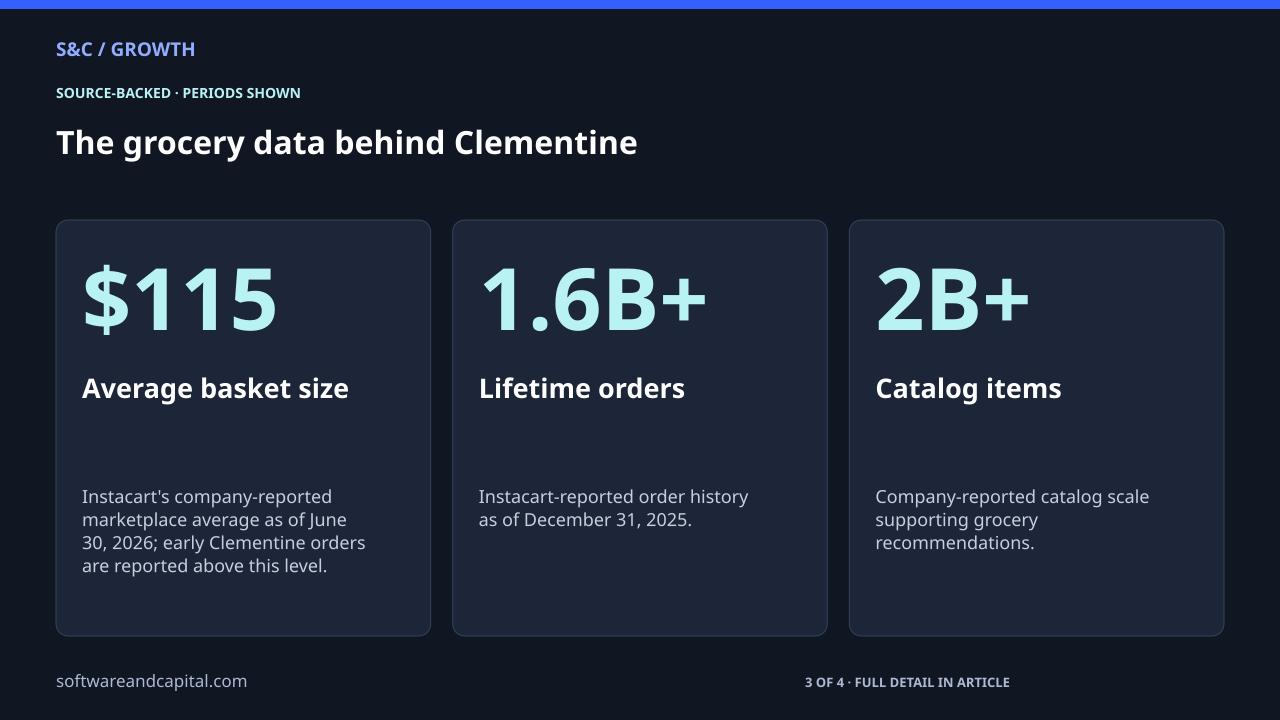
The grocery data behind Clementine
Instacart's company-reported marketplace average as of June 30, 2026; early Clementine orders are reported above this level.
The assistant is trying to solve the basket, not one search
Clementine can use a conversation, uploaded list or recipe as the starting point. Instacart says the assistant also uses preferences, order history, promotions and real-time store availability. The goal is not simply to recommend one product. It is to assemble a group of products that satisfies a household plan.1, 3
| Stage | What Clementine can use | What the customer gets |
|---|---|---|
| Intent | Conversation, recipe, handwritten or digital list | A plan for the shopping trip. |
| Personalization | Dietary preferences, brands and order history | Recommendations shaped to the household. |
| Store context | Inventory, prices, deals and substitutions | Products that are actually relevant to the selected store. |
| Basket | Multiple recommended items | A cart the customer can edit before checkout. |
The same intelligence can live outside Instacart
Instacart is also selling the underlying assistant technology to grocers through Cart Assistant. Retailers can put the experience on their own websites and apps, use their own catalog and customer data, and customize the branding. That creates a second distribution model alongside Clementine inside the Instacart marketplace.2, 1
The strategic tension is useful. Instacart wants consumers to start shopping inside Clementine, but it also wants retailers to use Instacart intelligence while keeping the retailer's own front door. The platform can therefore benefit whether the shopping conversation begins in Instacart or on a grocer's property.2
The $115 result is an early observation, not proof of causation
Instacart says early Clementine orders include more items than a typical basket and exceed the company's $115 average basket size. The announcement does not describe a randomized experiment, conversion-rate lift or profitability impact. Larger baskets could reflect who chooses to use the feature, what tasks they give it or the assistant itself.1
Grocery is unusually well suited to agentic commerce
A grocery basket is repetitive but highly contextual. The customer has dietary rules, brand preferences, a budget, a history of past purchases and a store with changing inventory. That gives an assistant many structured signals to turn a broad request into a transaction without inventing a completely new buying workflow.1
What to watch as grocery assistants spread
- Whether larger baskets persist after early adopters and launch effects fade.
- Whether retailers prefer white-label assistants or send more customers through marketplaces.
- How assistants handle substitutions, prices and out-of-stock items without increasing customer frustration.
- Whether conversational shopping changes advertising and product placement inside the basket-building process.
S&C's Shopify agentic-commerce analysis looked at AI as a new storefront for merchants. Clementine moves one step deeper into the purchase: the assistant is not only where a product is discovered. It is trying to assemble the entire order.
That makes grocery a useful test for agentic commerce because success is easy to define. The assistant has to produce a cart that fits the household, the store and the moment well enough that a person is willing to buy it.
Sources and methodology
Sources checked September 28, 2026. Dates and periods for individual figures are stated beside them.
- Instacart Investor Relations: Clementine launch ↗Accessed 2026-09-28
- Instacart: Cart Assistant for grocers' websites and apps ↗Accessed 2026-09-28
- Instacart Help Center: Clementine ↗Accessed 2026-09-28
Scope and assumptions
The larger-basket observation is company-reported and is not presented as a randomized causal test.
The $115 figure is Instacart's average basket size as of June 30, 2026, not a promised Clementine order value.
Product availability, retailer participation and AI behavior can change as Clementine and Cart Assistant continue to roll out.
Continue reading
AI Search Orders on Shopify Are Up Nearly 13×. Is Chat Becoming a Storefront? →
1M Businesses Already Use Meta’s AI Agent. Is Customer Service Becoming a Meta Product? →