For decades, using a computer mostly meant translating what you wanted into clicks and typed commands. Google’s latest Gemini usage data points toward something more natural: talk to the system, show it what you are looking at, or share the screen that is confusing you.1
Google says Gemini has surpassed one billion monthly users and that 63% of users now talk directly to it. One in five Gemini Live interactions goes beyond voice into live camera feeds or screen sharing. These are company-reported usage metrics, but they point to a broader interface shift: AI assistants increasingly receive spoken and visual context instead of only typed prompts.1, 2
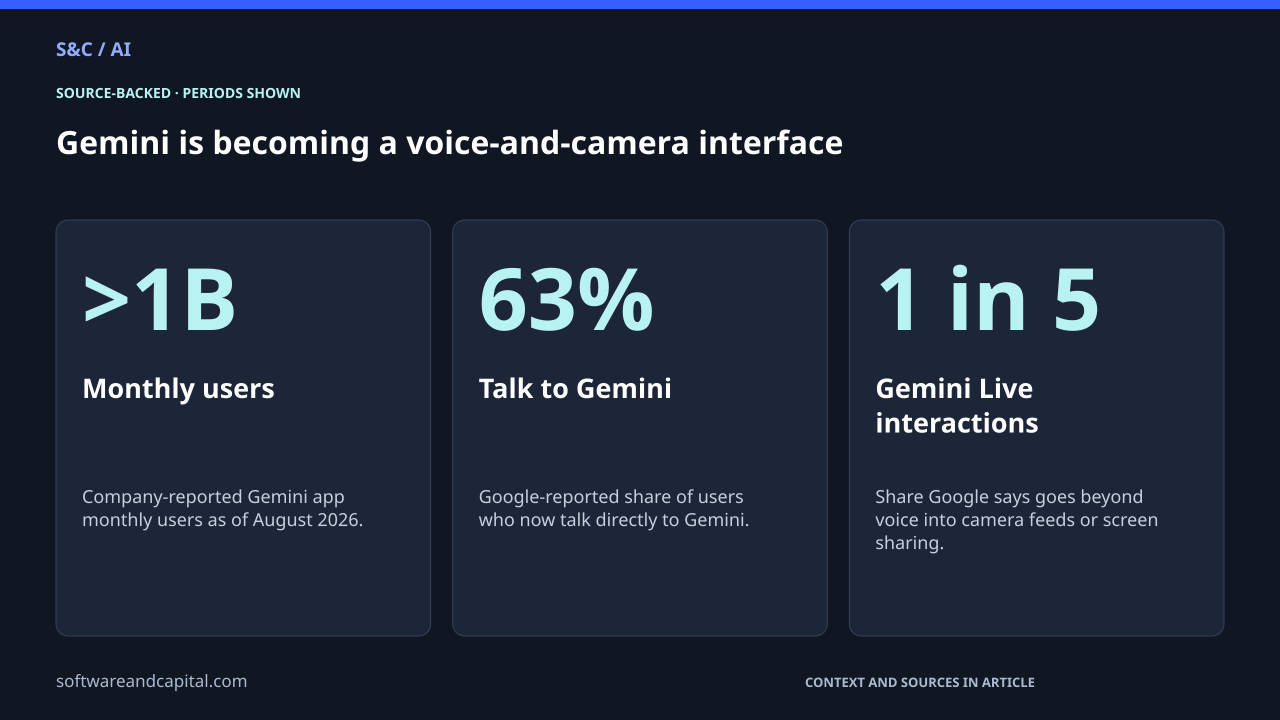
Gemini is becoming a voice-and-camera interface
These are Google’s own product metrics, not independently audited usage statistics. Their value is directional: voice is not a niche accessibility mode inside Gemini, and visual context is becoming a meaningful part of the product rather than a laboratory demo.1
Talking changes what people can ask while they are busy
Voice reduces the need to stop, unlock a device and type a carefully phrased request. Google says busy parents are more likely to use voice for everyday tasks. The interaction can happen while hands and eyes are occupied, which moves the assistant closer to activities rather than keeping it inside a text box.1
That does not make voice universally better. In a quiet office, a typed prompt can be faster, more private and easier to edit. The interface becomes more useful because people can choose the modality that fits the moment rather than because speech replaces text.
Camera and screen sharing add the context words struggle to describe
A live camera can show an object, a broken appliance or a physical workspace. Screen sharing can show an error message, a form or an application state. Instead of describing every detail, the user can provide the scene itself. Google’s one-in-five Gemini Live figure suggests a meaningful portion of Live use already takes advantage of that idea.1
| Mode | What the user supplies | Useful when |
|---|---|---|
| Text | Words and pasted information. | Precision, editing and quiet environments matter. |
| Voice | Spoken questions and follow-ups. | Hands are busy or conversation is the easiest input. |
| Camera | A live view of the physical world. | The problem is easier to show than describe. |
| Screen sharing | The current digital interface. | The assistant needs to see the app, page or error state. |
A richer interface also creates richer privacy questions
Showing an assistant the physical world or a screen can expose more context than a typed question. A camera view may include other people, documents or locations. A shared screen may contain messages or account information. The convenience therefore raises a simple discipline: share only the context needed for the task.
The same issue becomes even more visible with AI glasses if that separately approved article is published in the next release group. The interface can become more effortless as the sensor moves closer to the user, but the privacy boundary also becomes less obvious.
The assistant is starting to behave more like an interface layer
Google’s August AI update describes Gemini Live moving toward more task handling, while the billion-user post says Gemini can automate actions across dozens of Android apps. The product direction is therefore not only “answer better questions.” It is “understand more of the user’s context and act across more surfaces.”2, 1
That shift matters commercially because an assistant used across voice, camera, screens and apps can occupy more moments in the day. More moments do not automatically create more value, but they increase the range of tasks for which the product can compete.
What changes when the prompt leaves the text box
- Less translation: users can show or say what is happening instead of describing every detail.
- More context: the assistant can receive visual and interface information that text prompts often omit.
- More privacy exposure: richer context can include people and information unrelated to the task.
- More action: multimodal context makes it easier for assistants to help inside real workflows rather than only answer questions.
One billion monthly users is the headline scale. The more interesting change is how those people are interacting. If speaking, showing and sharing screens become normal, the next generation of AI may feel less like a website people visit and more like an interface layered over whatever they are already doing.
Sources and methodology
Sources checked September 22, 2026. Dates and periods for individual figures are stated beside them.
- Google: Gemini app surpasses one billion monthly users ↗Accessed 2026-09-22
- Google: AI announcements from August 2026 ↗Accessed 2026-09-22
Scope and assumptions
All adoption figures are Google-reported and depend on Google’s internal metric definitions.
The article does not claim voice or multimodal input is superior for every task, nor does it measure privacy outcomes.
Continue reading
5 AI Tools for Work: Choose by the Job, Not the Demo →
1B Weekly Users, 2.5M Businesses: OpenAI’s Two-Sided Growth Flywheel →
Millions Use AI Glasses Every Day. The Assistant Is Moving Onto Your Face →