Recruiting software first used AI to transcribe interviews and summarize notes. Metaview’s new $60 million round is built around a bigger claim: the software should execute chunks of the recruiting workflow itself—finding candidates, writing outreach, screening and scheduling.1, 2
Metaview raised a $60 million Series C, bringing total funding to $110 million. The company is expanding beyond interview intelligence into agents for sourcing, outreach, screening and scheduling. It says applications per recruiter have increased 412%, but that figure is company-reported without a published methodology. The more durable question is which recruiting steps can be delegated while consequential hiring judgments remain human.1, 2
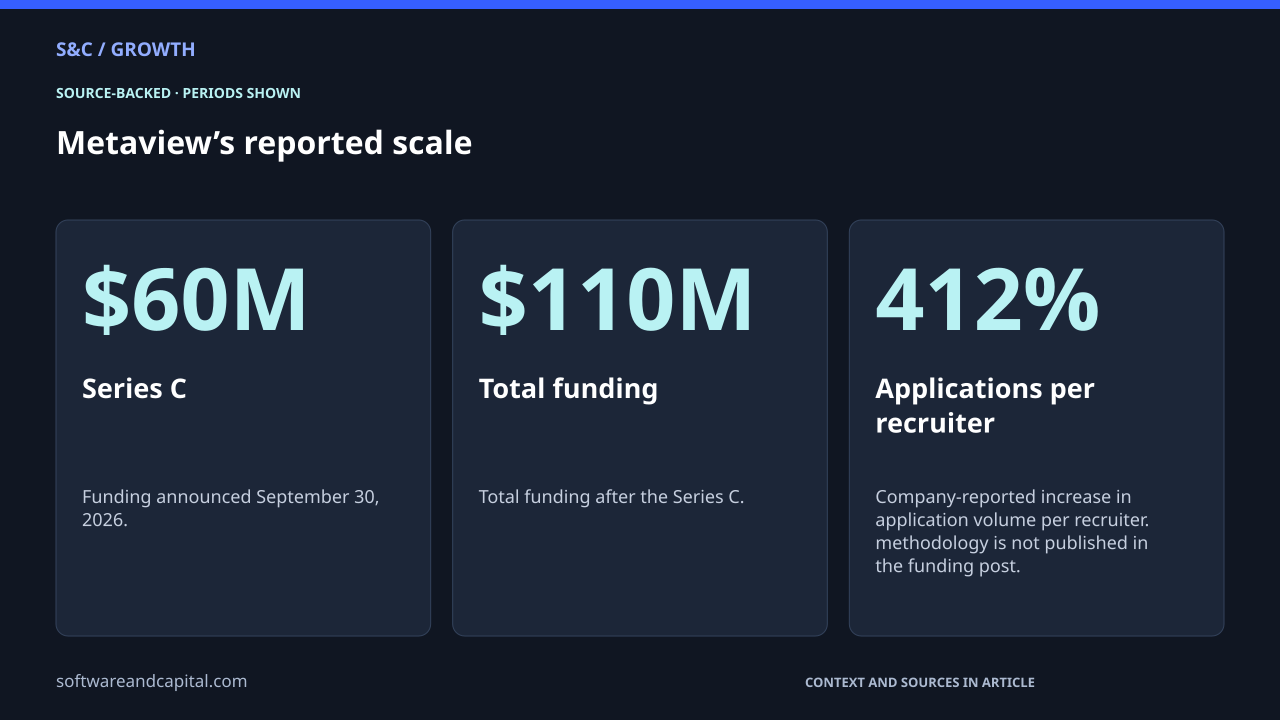
Metaview’s reported scale
The workflow is shifting from assistance to delegation
Metaview frames the next generation of recruiting software around agents that can execute sourcing, outreach, screening and scheduling. That moves AI from documenting recruiter work toward taking responsibility for bounded tasks within the hiring funnel.1
| Hiring stage | Agent-friendly work | Human decision |
|---|---|---|
| Sourcing | Search profiles and assemble candidate pools | Define who actually fits the role |
| Outreach | Draft and sequence personalized messages | Decide positioning and candidate priority |
| Screening | Collect structured information and route candidates | Interpret nuance and potential |
| Scheduling | Coordinate calendars and reminders | None for routine logistics |
| Selection | Summarize evidence | Make the consequential hiring decision |
More applications can make automation necessary and dangerous
If application volume is rising sharply, recruiters need leverage simply to process the queue. But high volume also raises the cost of a bad filter: an automated screen can remove large numbers of candidates before a person ever sees them.1
The recruiter may become the manager of a workflow
The coding-agent analogy in Metaview’s announcement is revealing. As with software agents, the human role can move toward specifying the goal, providing context, reviewing output and handling exceptions. In recruiting, that review layer matters because the decisions affect people’s livelihoods.1
Metrics that matter beyond time saved
- Qualified candidates surfaced per recruiter hour.
- Response and interview conversion by sourcing channel.
- False-negative or appeal rates from automated screening.
- Candidate experience and time-to-response.
- Quality and retention of eventual hires.
The interesting recruiting-agent story is not whether software can send more messages. It is whether teams can delegate repetitive work without automating away the judgment, accountability and relationship-building that make hiring consequential.
Sources and methodology
Sources checked October 1, 2026. Dates and periods for individual figures are stated beside them.
- Metaview: $60M Series C announcement ↗Accessed 2026-10-01
- Metaview: Recruiting platform ↗Accessed 2026-10-01
Scope and assumptions
The 412% applications-per-recruiter figure and other operational claims are company-reported without a disclosed methodology.
The article describes workflow design and does not establish the fairness or accuracy of any specific automated screening model.
Continue reading
A Securities Firm Put AI Coding Agents Across Its Entire Engineering Team →