A memory shortage becomes more concrete when customers start sending money years before all of the chips arrive. Micron says financial commitments tied to long-term supply agreements have reached $32 billion, up from $22 billion in June, with the majority backed by cash deposits.2
Micron says customer financial commitments under long-term supply agreements reached $32 billion, up from $22 billion in June, with most backed by cash deposits. The commitments help secure future memory supply but are not current revenue. They show customers sharing more capacity risk as AI demand tightens memory supply.1, 2
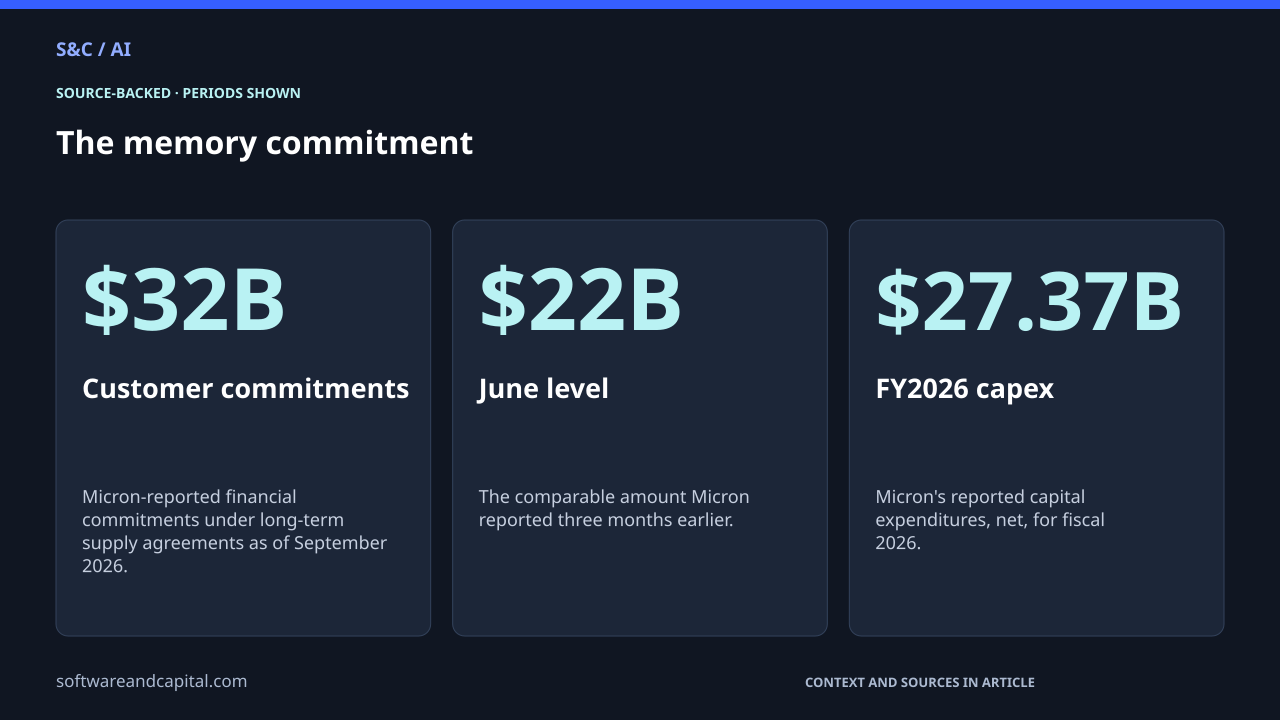
The memory commitment
Customers are sharing the capacity risk
A normal purchase order can be relatively short-dated. A long-term agreement with a deposit gives Micron stronger evidence that the customer intends to take future supply, while the customer gets a contractual position in a constrained market. That moves part of the risk of building capacity away from the manufacturer alone.2
| Number | What it represents | What it is not |
|---|---|---|
| Customer financial commitment | Contractual support for future supply agreements | Current-period revenue |
| Cash deposit | Money paid ahead under an agreement | Payment for chips already delivered |
| Capital expenditure | Micron's spending on manufacturing capacity and equipment | A direct measure of future revenue |
AI memory competes for finite manufacturing capacity
High-bandwidth memory is built from DRAM and uses manufacturing resources that could otherwise support other memory products. Micron says AI demand is driving tight conditions into fiscal 2027 and 2028, which makes allocation of future capacity commercially important.1, 2
A deposit is stronger than a forecast, but it is not guaranteed revenue
The $32 billion should not be added to Micron’s current sales. Revenue is recognized under accounting rules as products are delivered and obligations are satisfied. Contract terms, timing and future conditions still matter before a commitment becomes reported revenue.2
What to watch next
- How quickly Micron expands HBM and DRAM capacity relative to committed demand.
- Whether customer deposits keep rising as 2027 and 2028 capacity is allocated.
- How the mix of HBM and conventional DRAM affects supply and pricing across memory markets.
- How much of future contracted supply ultimately appears as recognized revenue.
The $32 billion number is valuable because it turns an abstract shortage into a contract. AI customers are not only saying they expect to need more memory. Many are putting capital behind access to future supply.
Sources and methodology
Sources checked September 30, 2026. Dates and periods for individual figures are stated beside them.
- Micron: fiscal Q4 and full-year 2026 results ↗Accessed 2026-09-30
- MarketBeat: Micron Q4 2026 earnings call transcript and highlights ↗Accessed 2026-09-30
Scope and assumptions
The $32 billion figure is a customer-commitment total, not current revenue.
Micron's future supply, pricing and recognized revenue can differ from today's contractual commitments.
Continue reading
Nvidia’s $193.7B Data-Center Business, Explained →
AI’s Next Constraint May Be Electricity, Not Intelligence →
Anthropic’s Reported $518B Compute Plan Is Mostly Contractual Commitments →