The most obvious construction-AI image is a robot on a jobsite. Miter’s $40 million Series B points somewhere less cinematic: payroll, compliance, invoices, safety reports and job costing—the administrative systems contractors already have to run every day.1
Miter raised a $40 million Series B, bringing total funding to $78 million. Its software combines payroll, HR, field operations, expenses and job-cost workflows for contractors, with AI used to parse invoices and receipts, structure pay-rate data, create safety reports and summarize job status. The case suggests construction AI may gain traction in digital back-office and field-administration work before autonomous machines replace physical trades.1, 2
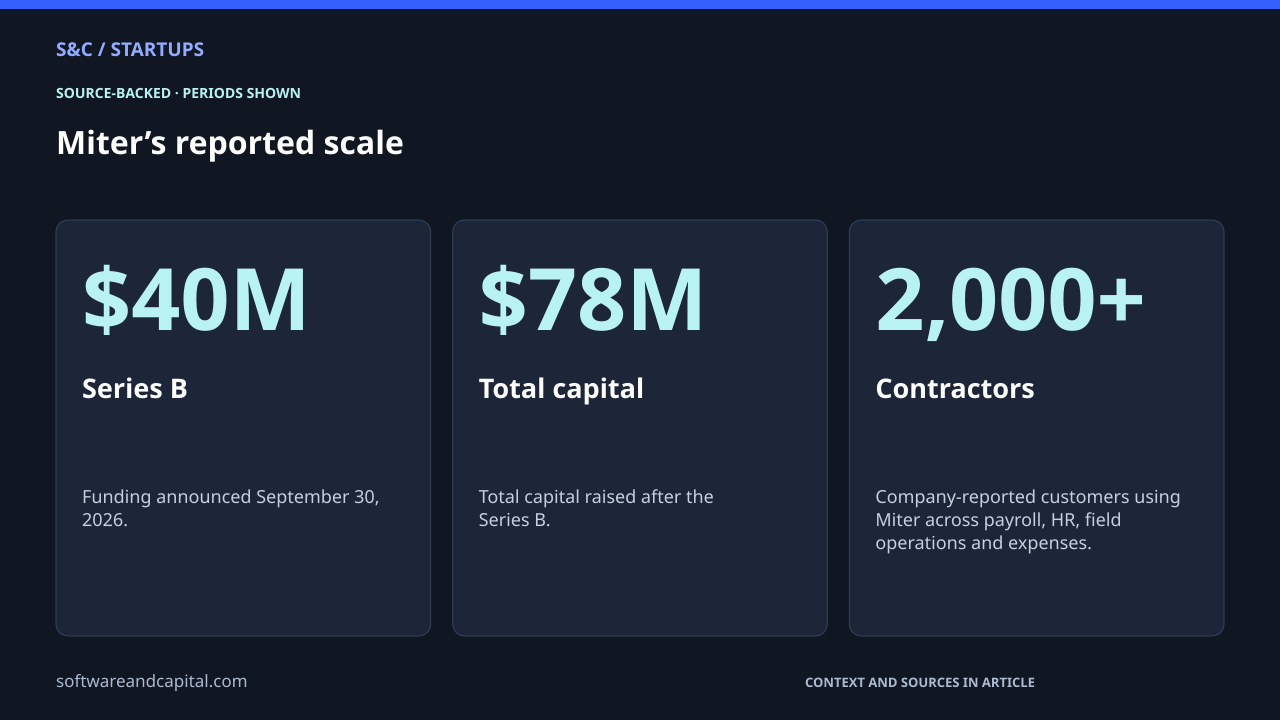
Miter’s reported scale
Back-office work is easier to digitize than a construction site
Invoices, timecards, pay rates, safety notes and job-cost records already exist as data or documents. Miter says its AI parses and structures these inputs and runs workflows that contractors previously handled manually.1, 2
| Workflow | Data already available | AI opportunity |
|---|---|---|
| Payroll / compliance | Timecards, rates, locations, rules | Structure inputs and flag exceptions |
| Accounts payable | Invoices and receipts | Extract fields and route approvals |
| Safety | Photos and voice notes | Draft structured safety reports |
| Job costing | Labor, materials and expense records | Surface cost trends before project close |
Vertical complexity is the reason generic software struggles
Construction payroll and accounting vary by project, state, union, wage rule and cost code. That complexity makes a horizontal tool harder to configure, but it also creates a deeper workflow moat for software built specifically around contractors.1
This is different from putting AI into the trades themselves
S&C’s ServiceTitan coverage examined AI entering field-service workflows. Miter’s emphasis is the operating system around construction companies: the administrative and financial coordination behind crews and jobsites rather than automating the craft work itself.
What would make the ROI clearer
- Measured reduction in payroll and compliance processing time.
- Lower error or rework rates on invoices and job-cost allocation.
- Evidence that AI features increase software retention or expansion revenue.
- Customer-level proof that field reporting changes project economics.
Construction may eventually be full of autonomous equipment. The nearer-term software opportunity is simpler: remove the paperwork and fragmented systems surrounding human crews. That is less futuristic, but it can reach a contractor’s costs much sooner.
Sources and methodology
Sources checked October 1, 2026. Dates and periods for individual figures are stated beside them.
- Miter: $40M Series B announcement ↗Accessed 2026-10-01
- Miter: Construction workforce platform ↗Accessed 2026-10-01
Scope and assumptions
Customer counts and product benefits are company-reported.
The announcement does not provide audited customer ROI or independent evidence that the AI features materially improve contractor margins.
Continue reading
AI Is Moving Into Plumbing and HVAC Software →
Entrata Nearly Doubled Revenue With Fewer Employees. It Credits AI for Much of the Efficiency →
EliseAI Says It Passed $200M ARR Before Raising at a $4B Valuation →