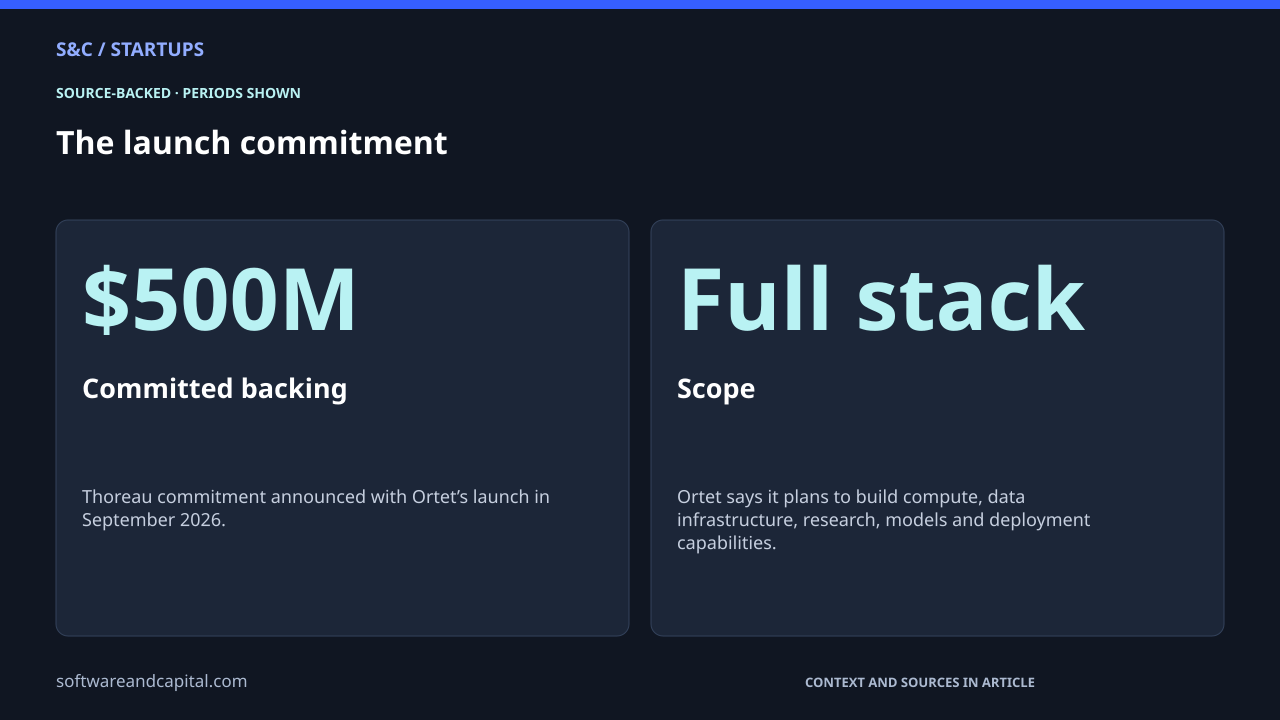
Most health AI companies start with a narrow product and raise more money as it works. Ortet is starting from the opposite direction. The new lab launched with a $500 million commitment from Thoreau to build compute, data infrastructure, frontier research and health models before a proven commercial product exists.1, 2
Ortet launched as a health-focused frontier AI lab with a $500 million commitment from Thoreau. The company plans to build across compute, data infrastructure, model research and deployment around a patient-centered health model. The $500 million is committed backing, not revenue. Product efficacy, commercial adoption and regulatory pathways remain unproven at launch.1, 2
The launch commitment
Health AI is expensive before the model even starts training
A patient-centered foundation model needs more than GPUs. Ortet’s own description spans compute, data infrastructure, model research, deployment and evaluation. Health adds another layer of difficulty because data is fragmented and clinical use requires trust, privacy and validation.1, 2
| Layer | What must exist | Why health makes it hard |
|---|---|---|
| Compute | Training and inference infrastructure | Frontier models are capital intensive |
| Data | Biological, clinical and operational information | Records are fragmented and sensitive |
| Research | Model architecture and evaluation | Patient-level prediction needs rigorous evidence |
| Deployment | Tools used in health workflows | Clinical and operational systems are complex |
| Validation | Safety, utility and governance | Health decisions carry consequential risk |
Committed capital is not revenue
The $500 million is backing from Thoreau, not evidence that customers have paid Ortet or that the company has achieved product-market fit. It gives the lab resources to build the stack, but it does not answer whether the resulting models will create clinical or commercial value.2
The ambition is broader than a single healthcare task
Ortet says it wants a shared intelligence foundation spanning biological, clinical and operational dimensions rather than a model for one narrow workflow. That breadth increases the possible value and the validation burden at the same time.1
The evidence Ortet still has to produce
- Independent performance evaluation on meaningful health tasks.
- Evidence that models improve decisions or workflows in real settings.
- Clear governance for privacy, safety and access to sensitive data.
- Commercial adoption that separates customer demand from investor backing.
The notable number is $500 million, but the useful lesson is about sequencing. Frontier health AI may require enormous capital before there is a product mature enough to judge. That makes validation, not fundraising, the next milestone that matters.
Sources and methodology
Sources checked October 1, 2026. Dates and periods for individual figures are stated beside them.
- Ortet: frontier AI lab for health ↗Accessed 2026-10-01
- Ortet launch announcement via Business Wire ↗Accessed 2026-10-01
Scope and assumptions
The $500 million is committed backing, not revenue or evidence of customer demand.
Ortet has not yet demonstrated product efficacy, clinical utility, regulatory clearance or broad commercial adoption.
Continue reading
Why So Much Medical AI Is Hiding in Radiology →
EliseAI Says It Passed $200M ARR Before Raising at a $4B Valuation →
An AI Drug Startup Reached the Clinic in About Two Years. Now Iambic Wants to Go Public →