Snowflake has 828 customers generating more than $1 million each in trailing-12-month product revenue. That number sounds like a contract-size statistic, but it is not. It is one of several different measures Snowflake reports to explain a consumption-based software business, alongside quarterly product revenue, net revenue retention and remaining performance obligations.1, 2
Snowflake reported $1.49 billion of Q2 fiscal 2027 product revenue, 828 customers above $1 million in trailing-12-month product revenue, 126% net revenue retention and $9.0 billion of remaining performance obligations. Those metrics describe different things: current-period consumption, large-customer spend, expansion within existing customers and contracted future revenue.1, 2, 3
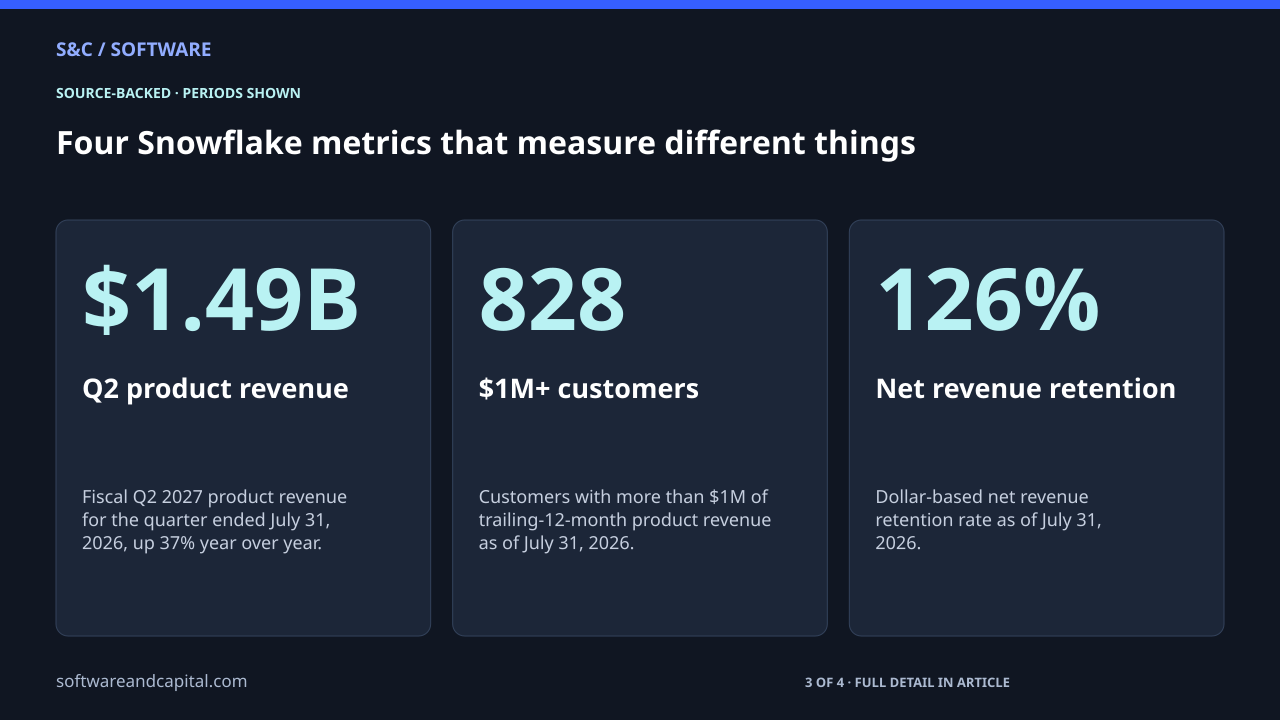
Four Snowflake metrics that measure different things
Fiscal Q2 2027 product revenue for the quarter ended July 31, 2026, up 37% year over year.
Customers with more than $1M of trailing-12-month product revenue as of July 31, 2026.
The $1 million customer threshold is trailing product revenue
Snowflake's 10-Q says the 828 customers each contributed more than $1 million of product revenue over the trailing 12 months. That is not contract value, annual subscription price or profit per customer. Snowflake also says those customers represented about 68% of trailing product revenue, which shows how much consumption is concentrated in its largest accounts.2
| Metric | Unit | What it answers |
|---|---|---|
| Product revenue | Revenue recognized in the quarter | How much product consumption turned into reported revenue now? |
| $1M+ customers | Trailing-12-month product revenue per customer | How many customer accounts are consuming at large scale? |
| Net revenue retention | Expansion and contraction in the existing customer base | Are existing customers spending more or less over time? |
| RPO | Contracted future revenue not yet recognized | How much contracted business remains to be recognized later? |
RPO is contracted future revenue, not a revenue forecast
Snowflake defines remaining performance obligations as contracted future revenue that has not yet been recognized. Its 10-Q says the $9.0 billion balance includes deferred revenue and non-cancelable contracted amounts, while excluding on-demand arrangements with no minimum commitment. Timing still depends on future customer consumption.2
Consumption makes the contract and the revenue move differently
Snowflake says the substantial majority of revenue comes from existing customers under capacity arrangements. Customers can buy capacity before they consume it, then recognize revenue as workloads run. That is why RPO and quarterly product revenue can move differently even when both reflect the same underlying customer relationships.2
The AI commentary is management attribution, not a clean revenue split
Snowflake's CEO said AI is contributing to growth and product adoption. The filing does not provide a separate audited revenue line for AI workloads. The measurable facts are the revenue, customer, retention and RPO figures. The claim that AI is driving them belongs in management commentary, not in the same column as reported financial results.1
Four mistakes to avoid when reading consumption-software metrics
- Do not treat a $1M trailing-revenue customer as a $1M annual contract.
- Do not treat RPO as revenue already earned.
- Do not read net revenue retention as new-customer growth.
- Do not attribute all reported growth to AI without a disclosed revenue split.
This is a more specific version of S&C's cloud-growth analysis. That article asks whether cloud growth is accelerating. Snowflake's disclosure lets us look inside one consumption business and see which customer and contract metrics describe that growth.
The useful lesson is that a software company can publish several impressive numbers that are all true without being interchangeable. Snowflake's 828 large customers, 126% retention and $9 billion of RPO tell different stories about scale, expansion and future commitments. The business becomes clearer when the denominators stay separate.
Sources and methodology
Sources checked September 28, 2026. Dates and periods for individual figures are stated beside them.
- Snowflake: Q2 fiscal 2027 earnings release ↗Accessed 2026-09-28
- Snowflake: Form 10-Q for quarter ended July 31, 2026 ↗Accessed 2026-09-28
- Snowflake Investor Relations: Q2 fiscal 2027 metrics ↗Accessed 2026-09-28
Scope and assumptions
Snowflake's $1M customer count uses trailing product revenue per customer account, and a single organization with multiple accounts may be counted more than once under Snowflake's definition.
RPO timing depends on future consumption and is not equivalent to revenue already recognized or guaranteed quarterly revenue.
Management attributes growth partly to AI, but Snowflake does not disclose a separate audited AI revenue line.
Continue reading
Cloud Growth Is Accelerating Again. AI Demand Is the Common Thread →
OpenAI Is Bundling Premium Financial Data Into ChatGPT for Bankers →